

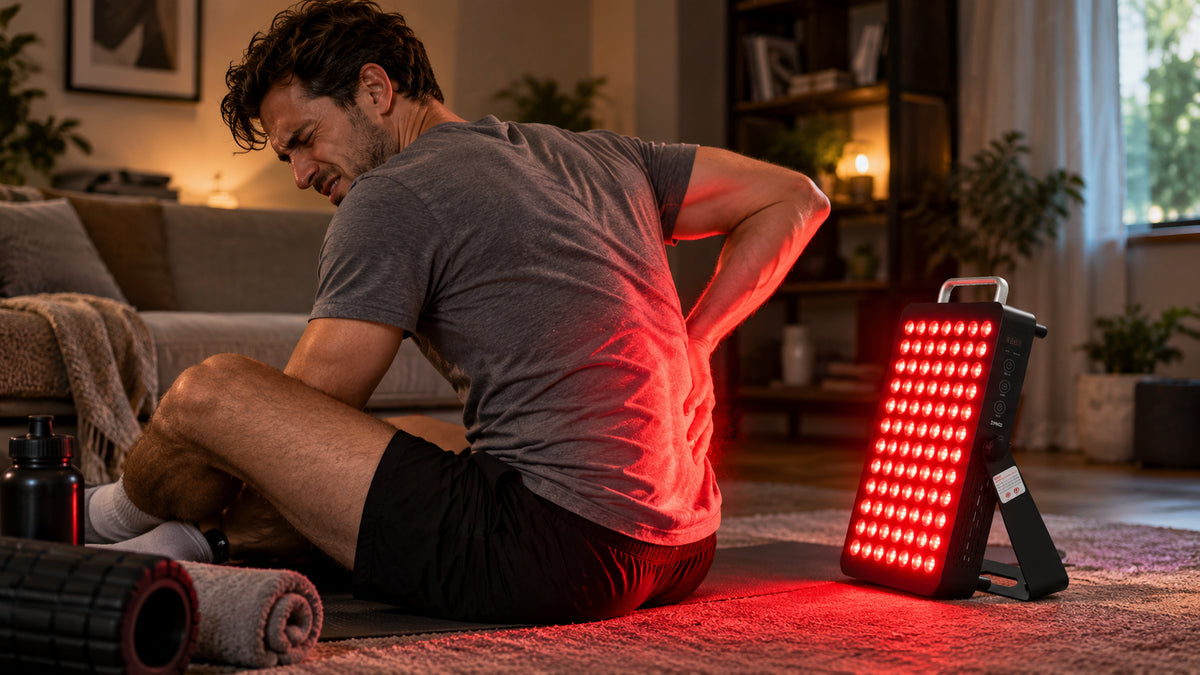
Beyond Ice Baths and Compression Sleeves: A Closer Look at Red Light Therapy for Muscle Recovery
Ever wake up after a tough workout with legs so sore that walking downstairs feels like a challenge?
Or maybe your discomfort comes from everyday life: stiff shoulders after hours at your desk, a tight lower back after a long drive, or soreness that keeps coming back despite stretching and heat therapy.
Ice baths, compression sleeves, foam rollers, and massage can all play a role in recovery. But they take time, and the relief doesn't always last. That's why some people are exploring red light therapy at home as another option for everyday muscle care.
Unlike approaches that rely mainly on temperature or pressure, red light therapy uses specific wavelengths of light to interact with cellular processes. So what does red light therapy do, and how do you choose the right device for home use?
This guide covers the science, three practical use cases, buying considerations, and the features of the SANSI 120W Dual-Wavelength Red Light Therapy Panel.
Table of Contents
- Why Does Recurring Muscle Soreness Keep Coming Back?
- What Is Red Light Therapy, and How Does It Work?
- Three Ways to Use Red Light Therapy at Home
- Three Mistakes to Avoid When Choosing a Red Light Therapy Device
- Why Choose the SANSI 120W Dual-Wavelength Red Light Therapy Panel?
- How to Use Red Light Therapy at Home
- Conclusion: Make Muscle Care Part of Your Routine
- About SANSI: Quality, Testing, and Customer Support
- Frequently Asked Questions
1. Why Does Recurring Muscle Soreness Keep Coming Back?
Repeated physical stress can leave muscle fibers with too little time to recover. Slower local circulation, a buildup of metabolic byproducts, and inflammatory factors may also contribute to lingering discomfort.
Over time, soreness and tension can feed into each other: pain → muscle spasms → increased tension → more discomfort.
Ice packs can temporarily reduce pain sensations, massage and foam rolling apply physical pressure, and heating pads provide warmth. These methods address discomfort in different ways, but they don't directly target the cellular energy processes discussed in photobiomodulation research.

A Different Approach to Muscle Recovery
Red light therapy takes a different approach: specific wavelengths of light interact with tissue, with the goal of supporting cellular energy metabolism and local recovery processes rather than relying on heat or pressure alone.
2. What Is Red Light Therapy, and How Does It Work?
What is red light therapy? Also called photobiomodulation (PBM), it goes beyond a red-colored heat lamp: it uses specific wavelengths of red and near-infrared light that interact with biological tissue.
660nm vs. 850nm: What’s the Difference?
660nm red light is visible and reaches the skin and relatively shallow tissue layers.
850nm near-infrared light is invisible to the human eye and can reach deeper tissue. Its penetration depth is described as approximately 5–10 mm, making it relevant to applications involving muscles and joints.
Using both wavelengths gives a home red light therapy panel flexibility for different target areas. The actual wavelengths matter more than whether the lamp simply looks red.

How Does Red Light Therapy Work at the Cellular Level?
How does red light therapy work? Photobiomodulation research examines how certain wavelengths interact with enzymes in mitochondria, which help cells produce energy. This is the basis for proposed effects on energy metabolism, microcirculation, and recovery.
In everyday terms, the goal is to support processes the body uses during recovery. Unlike a heating pad, red light therapy is based on light-tissue interactions rather than warmth alone.
Research on medical applications of LED light includes work described by NASA Spinoff; see the references below.
Red Light Therapy Benefits for Everyday Muscle Care
One practical benefit of red light therapy for home users is convenience. When comparing devices, consider the areas you want to target, how easily you can position the light, and whether the routine fits your schedule.
- Which areas of your body need attention most often?
- Is the device easy to position and adjust?
- Can you use it consistently without disrupting your schedule?
3. Three Ways to Use Red Light Therapy at Home
Whether you’re getting back into your routine after a workout, unwinding after a long workday, or dealing with recurring muscle tightness, a home red light therapy panel can fit naturally into everyday life.

1. After Workouts: Support Recovery for Your Legs, Shoulders, and Back
After a run, strength workout, or game, your legs, shoulders, and back may feel tired and sore. A red light therapy panel gives you a convenient way to include those areas in your post-workout recovery routine.
You can make time for muscle care at home without preparing an ice bath or putting on compression sleeves.
2. After Desk Work: Relax Tight Neck and Shoulder Muscles
Spending hours at a desk can leave your neck, shoulders, and upper back feeling tight. After work, a red light therapy session offers a simple way to unwind and focus on those areas.
It can fit into the time you already spend reading, relaxing on the couch, or taking a break at the end of the day.
Unlike massage, it doesn’t require repeated physical pressure. And unlike a heating pad, it doesn’t rely on warmth that gradually fades.
3. For Long-Standing Discomfort: Build a Convenient Home Routine
Recurring lower-back or knee discomfort can be frustrating, especially when relief from a massage doesn’t last. Having a red light therapy panel at home makes it easier to include muscle care in your routine.
Keep it in your living room or home office, and adjust the angle to target the area you want to focus on. When a routine fits into everyday life, it’s easier to stick with it.
4. Three Mistakes to Avoid When Choosing a Red Light Therapy Device
Not every lamp that looks red is a purpose-built red light therapy device. If you're comparing red light therapy panels for home use, start with three things: wavelengths, measured light output, and quality documentation.
Mistake #1: Choosing Based on Color Instead of Wavelength
Some inexpensive products use ordinary red LEDs, including wavelengths around 620nm, without clear calibration. Color alone doesn't tell you whether a device emits the intended wavelengths.
What to check: Clearly identified peak wavelengths, such as 660nm and 850nm, rather than a vague claim that the lamp emits 'red light.'
Mistake #2: Assuming Higher Wattage Always Means Better Results
Wattage measures electrical power, not necessarily how much light reaches your skin. For red light therapy at home, irradiance and how evenly the light is distributed are more useful points of comparison.
What to check: Irradiance measurements with the test distance stated. Excessively concentrated output can also affect comfort.
Mistake #3: Ignoring Certifications and Warranty Support
For a device used close to the body, clear technical documentation and dependable after-sales support matter. Look for relevant registration or certification information, testing records, and warranty coverage.
What to check: Relevant documentation, clear warranty terms, and accessible customer support.
Look for accurate wavelengths, consistent light output, and reliable quality assurance. With those factors in mind, here’s how the SANSI 120W Dual-Wavelength Red Light Therapy Panel puts them into practice.
5. Why Choose the SANSI 120W Dual-Wavelength Red Light Therapy Panel?

SANSI 120W Dual-Wavelength Red Light Therapy Panel
The SANSI 120W Dual-Wavelength Red Light Therapy Panel combines 660nm red light and 850nm near-infrared light with practical features designed for everyday home use.
Dual-Chip LEDs for More Uniform Light Coverage
SANSI uses dual-chip LED packages, each combining a 660nm red-light chip and an 850nm near-infrared chip in the same LED position.

With a single-chip design, each LED emits only one wavelength, so red and near-infrared LEDs must be arranged separately across the panel. That can create less even coverage.
By combining both wavelengths in each LED package, SANSI’s design helps distribute red and near-infrared light more consistently across the target area.
High Irradiance: 136 mW/cm² at 3 Inches
The panel's stated irradiance is 136 mW/cm² at 3 inches (7.6 cm). Specifying the measurement distance makes this figure more useful when comparing products.
The panel does not need to touch your skin. It also includes three preset timer options for different routines.

Fanless Ceramic Cooling for a Quieter Experience
Many panels use an aluminum board and fan to manage heat. Fans can add noise and introduce another moving component that may need maintenance.
SANSI instead mounts LEDs directly onto a ceramic heat sink and uses a fanless, natural-convection design. That means less background noise when you’re reading, resting, or winding down.
The ceramic heat sink helps dissipate heat without relying on a fan.
For a routine you use regularly, less background noise is a meaningful convenience.

External Driver and Low-Voltage Power Design
SANSI places the driver outside the main panel housing and supplies the light through an external, low-voltage adapter. This keeps household high voltage out of the panel itself.
The external power adapter is designed to help reduce electromagnetic fields (EMF) around the red light therapy panel.

Adjustable U-Shaped Stand for Easy Positioning
An adjustable U-shaped stand lets you angle the panel toward your shoulders, back, or legs without holding it during a session.
That small convenience matters when you're trying to maintain a consistent routine at home.


6. How to Use Red Light Therapy at Home: Distance, Duration, Frequency, and Safety
Follow the SANSI 120W product guidance for 660nm + 850nm muscle recovery and relaxation. Other applications, including 850nm-only localized body care, use different settings.
- Recommended Distance: Keep the panel approximately 3–6 inches (7.6–15.2 cm) from the target area. Irradiance increases as the distance between the panel and the skin decreases. For reference, the SANSI 120W panel delivers 136 mW/cm² at 3 inches (7.6 cm). Direct contact with the skin is not necessary.
- Recommended Session Duration: A typical session lasts 4–8 minutes per target area. The SANSI panel offers three preset exposure durations, allowing users to select the setting that best suits their needs.
- Recommended Frequency: Use the device 3–5 times per week. Consistent use may produce more stable results over time. Many users may begin noticing gradual changes after approximately 2–4 weeks, although individual experiences vary.
- Safety Precautions: Close your eyes or wear protective eyewear during exposure, and avoid looking directly at the light source for extended periods. Avoid using the device on broken skin, areas of acute inflammation, or malignant tumors. Pregnant individuals, people with photosensitive conditions, and those taking photosensitizing medications should consult a healthcare professional before use. Stop using the device if you experience persistent redness, overheating, or discomfort.
7. Conclusion: Make Muscle Care Part of Your Routine
Photobiomodulation has been studied for a range of applications, including post-exercise soreness. For home users, its appeal is a noninvasive option that can fit into an existing muscle-care routine.
It doesn't require an ice bath, compression sleeves, or a trip to a clinic. The key is choosing a suitable device and following its instructions.
8. About SANSI: Quality, Testing, and Customer Support
For a device you plan to use regularly, technical specifications matter. So do build quality, testing, and customer support.
More Than 30 Years of LED Lighting Experience
With more than 30 years of experience developing LED lighting products, SANSI has built expertise in light-source design and thermal management. The brand brings that experience to its red light therapy products.
SANSI grow lights have consistently ranked among leading products in relevant Amazon categories, and the brand has a 26% repeat-purchase rate.
Three-Year Warranty and Customer Support
The SANSI 120W Dual-Wavelength Red Light Therapy Panel comes with a three-year warranty, backed by customer support for product-related questions and concerns.
FDA Establishment Registration and Device Listing
The SANSI 120W Dual-Wavelength Red Light Therapy Panel has FDA establishment registration and device listing information under registration number 3017236146.
Factory Testing and Measurable Performance
The SANSI 120W Dual-Wavelength Red Light Therapy Panel undergoes spectral and irradiance testing before leaving the factory, including measurements of peak wavelengths and light intensity at different distances.

9. Frequently Asked Questions
Does Red Light Therapy Really Work?
Research on photobiomodulation suggests that red and near-infrared light may help ease delayed-onset muscle soreness (DOMS) after exercise. This is one reason people include it in their muscle-recovery routines.
What Does Red Light Therapy Do for Your Muscles?
Red light therapy uses specific wavelengths of red and near-infrared light to interact with cellular energy processes. For muscle care, people include it in their post-workout recovery, relaxation, and everyday wellness routines.
How Long Should You Use Red Light Therapy at Home?
For the SANSI 120W panel’s 660nm + 850nm muscle-recovery mode, use 4–8 minutes per area at a distance of 3–6 inches, 3–5 times per week. With consistent use, changes may become noticeable over 2–4 weeks, although experiences vary.
Is Red Light Therapy Safe for Your Eyes?
Avoid staring at the LEDs. Close your eyes or use suitable protective eyewear, particularly for facial sessions, and follow the device instructions.
What’s the Difference Between 660nm and 850nm?
660nm is visible red light associated with shallower tissue exposure; 850nm is invisible near-infrared light that can penetrate farther. The two wavelengths are combined in SANSI's dual-chip panel.
Can I Use Red Light Therapy Every Day?
Frequency depends on the application. For 660nm + 850nm muscle recovery, SANSI recommends 3–5 sessions weekly. Its separate 850nm localized body-care guidance lists 1–2 sessions daily.
What Should You Look for in a Red Light Therapy Panel for Home Use?
When choosing a red light therapy panel for home use, look for clearly stated wavelengths, irradiance measured at a specified distance, an adjustable setup, and dependable warranty support. Professional equipment may differ in power, coverage, and operation.
Explore the SANSI 120W Dual-Wavelength Red Light Therapy Panel
Explore the SANSI 120W Dual-Wavelength Red Light Therapy Panel, featuring dual-wavelength LEDs, fanless ceramic cooling, and an adjustable stand designed for home use.
Explore the SANSI 120W Dual-Wavelength Red Light Therapy Panel
Browse More SANSI Red Light Therapy Products
References and Sources
NASA Research Illuminates Medical Uses of Light — NASA Spinoff
Condividere:
Light Up Your Life: The Ultimate LED Light Bulb Buying Guide for Homes
How to Use Red Light Therapy at Home: Showers and Sauna Tents