

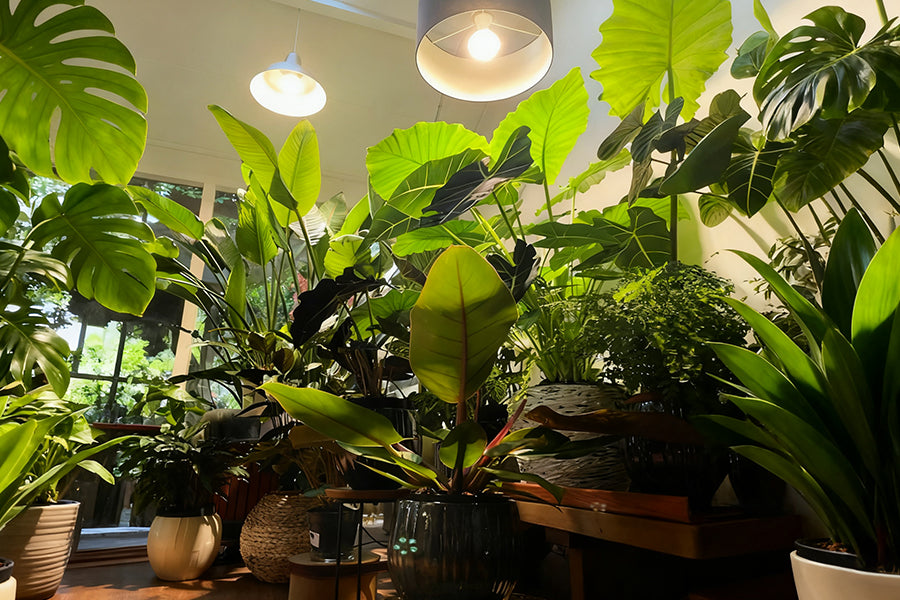
If you want beautiful tropical plants in your home that thrive for years—not just last for a few months—there is one factor that matters more than water, soil, or fertilizer: Light.
Recently, renowned YouTube plant expert @SheffieldMadePlants conducted an independent, rigorous 3-month side-by-side review of our SANSI 36W Ceramic Grow Bulb against another prominent premium brand in the market. The real-world results filled our team with immense pride, as they strongly validated the efficacy of the patented ceramic heat dissipation technology we have championed for years. Below, we have compiled the honest data, technical insights, and real-world findings from this test to help you choose the perfect setup for your indoor jungle.

3 Golden Rules for Using Grow Lights in Real Homes
Many indoor gardeners make the mistake of buying a light and sticking it anywhere. To get the best results, you need to mimic nature by mastering three elements:
1. Distance and Placement
Keep the light close enough to trigger active photosynthesis, but not so close that you end up bleaching or burning the leaves.
- For smaller bulbs (like a 10W bulb), a distance of 20 to 30 cm (8–12 inches) is ideal due to its narrower beam.
- For larger, more powerful bulbs (like a 36W bulb), you can place them further away—around 60 cm (2 feet)—as they spread light over a wider canopy.
2. The Golden Angle (Don't Mount Directly Overhead!)
Instead of hanging your light directly above the plant—which forces all the leaves to awkwardly point straight up at the ceiling—angle the light down onto the plant from the front or side. This mimics the natural angling of the sun, encouraging the leaves to face out into the room, showing off their beautiful foliage where you can actually enjoy them.
Instead of hanging your light directly above the plant—which forces all the leaves to awkwardly point straight up at the ceiling—angle the light down onto the plant from the front or side. This mimics the natural angling of the sun, encouraging the leaves to face out into the room, showing off their beautiful foliage where you can actually enjoy them.
 3. Respect the Night Cycle
It is tempting to leave your grow lights on 24/7 to "turbocharge" growth, but this will actually exhaust and damage your plants. Plants need a night cycle just as much as humans do; it's when they recharge. Aim for 12 hours of daylight and 12 hours of darkness as a baseline (maximum 16 hours on).
The Danger of Going Cheap (and Why "Blurple" Lights Fail)
The biggest mistake most plant parents make is buying random, ultra-cheap grow lights from Amazon. Not only do these lights lack longevity, but their performance is often near zero. You end up paying for the upfront cost and the electricity, only to watch your plants slowly stretch and decline.
Another common pitfall is buying those bright purple ("blurple") lights. While they target specific agricultural needs like commercial fruiting, they look jarring and unattractive in a cozy living room. For indoor house plants, you are much better off with a Full-Spectrum, natural-looking white light that complements your interior design while feeding your plants.

Head-to-Head: SANSI 36W vs. Premium Competitor (Soltech Vita)
When looking for a premium full-spectrum screw-in grow bulb that fits standard home lamps, two names frequently come up: the SANSI 36W Ceramic Grow Bulb and the Soltech Vita (20W).
We put both bulbs to the test in a direct, 3-month side-by-side comparison on the exact same plant shelf. Here is how they stack up in the real world:
1. Power & Usable Light (The PPF Factor)
Soltech Vita: 20W
SANSI Bulb: 36W
On paper and in reality, more power means more usable light reaching your plants. SANSI pushes out a significantly higher amount of PPF (Photosynthetic Photon Flux)—the scientific metric for light that plants can actually use for growth.

2. Optical Lens Design vs. Light Spill
The Soltech bulb functions similarly to a standard household light bulb; it spreads a very soft, warm light everywhere. While it blends into a room, it spills a lot of valuable light into the living space instead of directing it to the plant.
Conversely, the SANSI bulb is engineered as a precision tool. It uses a specialized optical lens to concentrate and drive the light downward directly onto the canopy. Because more targeted photons are hitting the foliage, plants show a visibly happier response, actively presenting their leaves toward the SANSI light.
 3. Patented Heat Dissipation Technology
Both bulbs do an excellent job of managing heat, remaining warm but never dangerously hot to the touch. SANSI achieves this through its signature technological innovation: instead of trapping heat inside the bulb, the heat is pulled away from the LED chips and efficiently released through the ceramic surface. This keeps the internals running at peak efficiency for years.
4. Smart Control & Functionality
Life gets busy, and nobody wants to manually flip switches every morning and night. The SANSI bulb comes equipped with a convenient remote control and smart timer features. You can easily set your schedule and forget it, ensuring your plants get their perfect 12-hour cycle automatically.

5. Price vs. Value (The Ultimate Clincher)
Perhaps the most surprising finding of this head-to-head test is the cost. The Soltech Vita retails for roughly double the price of the SANSI 36W bulb, despite offering almost half the wattage and power. While Soltech markets heavily on minimal aesthetics, SANSI delivers unparalleled, professional-grade performance. And once you screw the SANSI bulb into a stylish floor or desk lamp that matches your decor, you get the absolute best of both worlds: stunning interior aesthetics and raw growing power.
|
Feature |
Soltech Vita |
|
|
Wattage |
20W |
36W (More Power) |
|
Light Distribution |
Wide Spill |
Focused Optical Lens |
|
Smart Features |
None |
Remote Control & Built-in Timer |
|
Warranty Support |
Repair-focused |
Hassle-free Replacement Warranty |
|
Price |
~2x Expensive |
Highly Cost-Effective |

The Science Behind SANSI's Design: Addressing the Reviewer’s Feedback
While the reviewer praised SANSI’s raw growing power, they noted two distinct differences: SANSI bulbs carry more physical weight and emit a brighter, cooler daylight color tone compared to standard aesthetic household bulbs.
At SANSI, these design choices are intentional, scientific, and engineered entirely for the long-term health of your plants. Here is why:
Why SANSI Bulbs Have More Weight:
The Power of Premium Ceramic & No Plastic Outers
Many cheap or purely decorative bulbs on the market rely on thin, lightweight plastic outers or bulky aluminum heatsinks. Plastic is a terrible thermal conductor; it traps heat inside, causing rapid light decay (dimming) and a heavily shortened lifespan for the LED chips.
SANSI completely rejects flimsy plastic shells. Our bulbs feature more physical substance because they are built with our proprietary [INTERNAL LINK PLACEHOLDER: Click here to learn about SANSI's patented COC. By welding the LED chips directly onto non-conductive ceramic bodies, the bulb pulls damaging heat away instantly and releases it through the surface. It is heavier because it is a professional-grade, solid ceramic powerhouse engineered to prevent light decay and run efficiently for years.

Why We Choose 4000K Daylight Over Dim Warm Light:
1:1 True Color Restoration
While dim, ultra-warm yellow lights function well as ambient evening lifestyle lamps for humans, they are fundamentally insufficient for tropical plant photosynthesis. In nature, tropical canopies crave the intense, nourishing light of the midday sun.
The SANSI bulb emits a crisp, 4000K natural daylight spectrum. This specific temperature mimics natural sunlight at noon, providing a scientifically balanced full-spectrum distribution that fuels explosive vegetative growth. Furthermore, our high-performance diodes offer a superior Color Rendering Index (CRI), allowing for 1:1 true-to-life color reproduction. Under SANSI lights, your plants don't look washed out or artificially yellowed—you see their rich, vibrant, natural greens exactly as nature intended.

The Verdict: Which One is Right for You?
If you are looking for a subtle, low-powered accent light and budget is no objection, the competitor’s bulb is an aesthetic option.
However, if your primary goal is healthy, explosive plant growth, scientific light efficiency, and smart automated features at half the price, the SANSI 36W Ceramic Grow Bulb is the undisputed winner. It is a true grower's tool wrapped in a home-friendly format.
Ready to give your indoor jungle the daylight it deserves?
Click the link:SANSI 36W Ceramic Bulb
Video Credit & Special Thanks
This article and the insights shared above are based on an independent, honest product review by the talented indoor plant expert and creator, @SheffieldMadePlants, on YouTube.
If you want to see the 3-month side-by-side growth test, watch the live light spill comparison, and check out his beautiful real-life living room setup in action, we highly recommend watching his full video!
Watch the Full Review Here: SANSI vs Soltech Grow Bulb: An Honest 3-Month Comparison
A huge thank you to @SheffieldMadePlants for providing such a thorough, scientific, and practical breakdown for the plant community!
Share:
Mid-Year Sprint: Get the Best Grow Light Deal
My Indoor Banana Plant Saga: Hope, Drama & Bad Decisions