

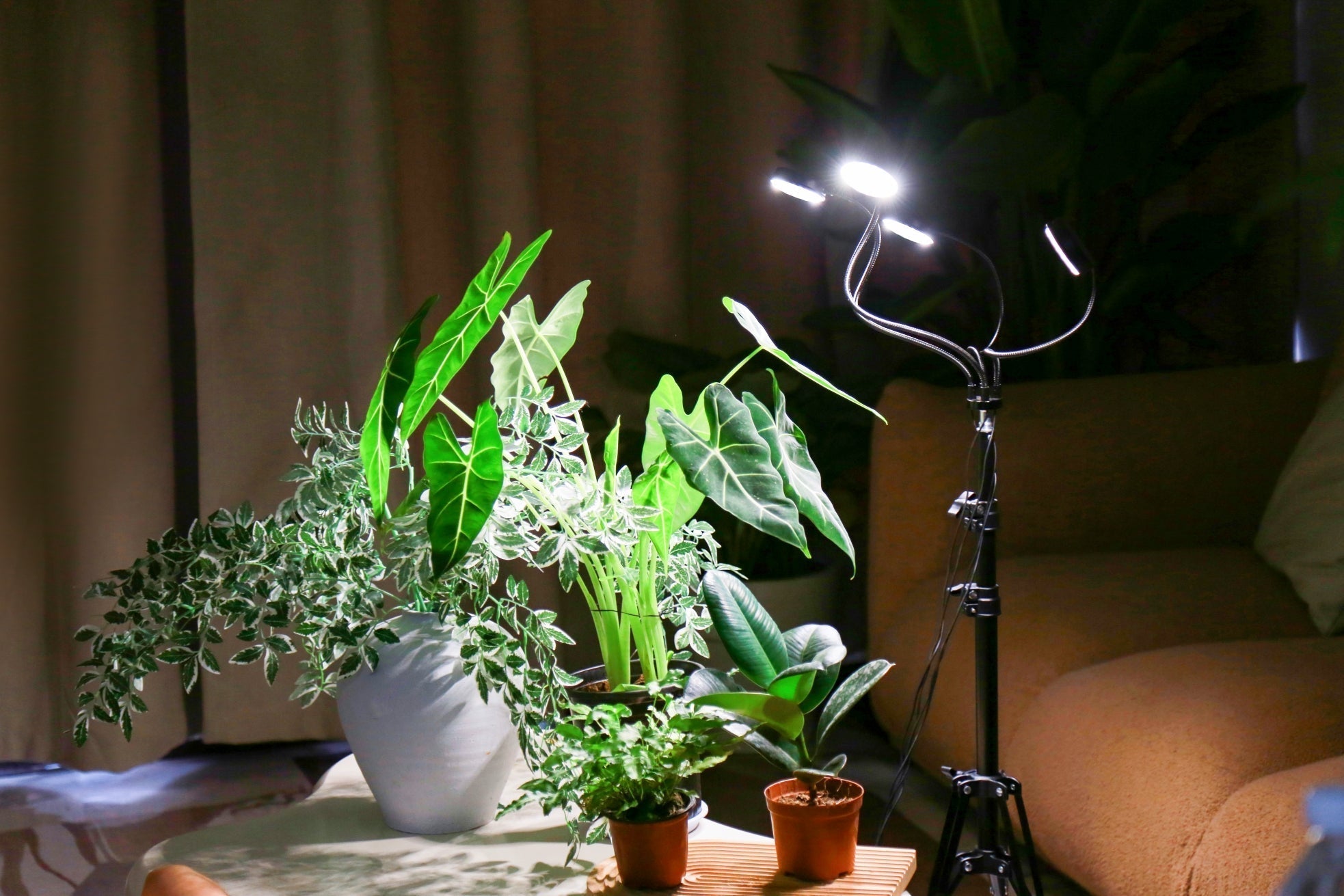
Have you ever wondered if that LED lamp illuminating your dim desk could nourish your windowsill plants like sunlight? With the rise of indoor gardening, more plant enthusiasts are exploring this question. Today, we'll unveil the mystery of how LEDs boost plant growth, exploring their transformation from ordinary lighting tools into the “artificial sun” for indoor plants.
Table of Contents
LED Plant Grow Lights: A “Custom Recipe” for Plants
Why Are LEDs the Best Choice for Plants?
LED Plant Grow Lights VS. Regular Household LED Lights
Red-Blue Spectrum VS. Full Spectrum: Which Do Plants Prefer?
How to Choose the Right LED Light for Your Houseplants?
LED Grow Lights: The Indoor Gardener's Trusted Companion
LED Grow Lights: Plants' “Custom-Made Diet”
If light is the “staple food” for plants, then “chlorophyll” acts as their mouth. Through photosynthesis, plants convert light energy into chemical energy, enabling growth, flowering, and fruiting. Yet like humans, plants are picky gourmets. Chlorophyll doesn't “consume” all light—it favors blue light (wavelengths around 400-500nm) and red light (wavelengths around 600-700nm). Supplementing plant light is essentially serving them a carefully calibrated “spectrum feast.”
Why are LEDs the optimal choice for plants?
In the field of supplemental plant lighting, LEDs have become the mainstream solution due to their unparalleled four key advantages:
· High Efficiency & Energy Savings: LEDs convert more electrical energy into light rather than heat, achieving far greater efficiency than traditional light sources like incandescent or fluorescent bulbs. They provide more effective illumination while generating less heat, significantly reducing electricity costs.
· Customizable Spectrum: Precisely adjusts the ratio of blue and red light to deliver optimal illumination for each plant growth stage, eliminating energy waste on ineffective wavelengths.
· Low Heat Emission: Generates minimal heat during operation, allowing close placement without leaf burn. This maximizes space utilization and safety.
· Extended Lifespan: Lasts tens of thousands of hours—far exceeding traditional bulbs—reducing the hassle of frequent replacements.
LED Plant Grow Lights VS. Regular Household LED Lights

Standard household LED lights are designed for human vision, emitting comfortable white light. Their spectrum is not optimized for plant growth; excessive green and yellow light is not absorbed by plants. Both light intensity and wavelength bands fail to meet plant growth requirements. Under such lighting conditions, plants become increasingly weak and leggy because they lack the optimal light quality and intensity needed.
Full-spectrum LED plant grow lights are specifically engineered for plant photosynthesis. These lights mimic the continuous spectrum of sunlight, utilizing specialized phosphors and chips to deliver blue light (430-450nm) and red light (640-660nm) – the wavelengths most efficiently absorbed by chlorophyll a and b. While maintaining visual comfort for human eyes, they provide higher light intensity, converting more electrical energy into plant-usable light to meet growth requirements.
Therefore, not all LED lights achieve optimal results for plant growth. To ensure healthy indoor cultivation under dim conditions, you may require a specialized LED plant grow light.
Red-Blue Spectrum VS. Full Spectrum: Which Do Plants Prefer?
Red light promotes stem elongation, flowering, and fruit ripening. It accelerates carbohydrate synthesis and accumulation during photosynthesis, resulting in more vibrant flowers and sweeter fruits. Ideal for flowering plants (e.g., orchids, bougainvillea) and fruiting vegetables (e.g., strawberries, cherry tomatoes). Blue light suppresses leggy growth, promoting sturdier plants with thicker stems and lush, vibrant foliage. It's ideal for foliage plants (e.g., calathea, monstera). However, the red-blue spectrum emits an unpleasantly purple-pink glow. Long-term household use not only distorts the plant's true color and health status but also exposes you to chronic blue light hazards.
Full-spectrum LED plant grow lights strike the perfect balance between cultivation efficiency and user experience. By simulating and optimizing the solar spectrum, they deliver comprehensive, balanced “light nutrition” to plants while minimizing blue light hazards. This provides comfortable, natural viewing light that harmonizes ornamental appeal with growth needs, catering to all plant species across their developmental stages. They nourish plants while safeguarding our health.

How to Choose the Right LED Grow Light for Your Plants?
With so many plant lights on the market, how should we make the right choice? Just follow these tips to make an informed decision:
Choose Products Based on Effective Light Output
For the same wattage, select products with higher PPFD. At the same mounting height, SANSI plant grow lights deliver significantly higher PPFD than competitors, providing greater illuminance. They distribute light precisely and evenly across the illuminated surface, minimizing light scatter and spill. This ensures every bit of light energy is efficiently utilized for plant photosynthesis.

SANSI products achieve brighter and more uniform illumination than poorly designed products of equivalent power consumption through superior optical lens design, all while consuming less energy. This means: choosing SANSI allows you to achieve better cultivation results while paying lower electricity bills.

Determine wattage based on planting area
Power (watts) determines the intensity and coverage area of the light. Low-power lamps (<20W) are suitable for small potted plants on a desk; medium-power lamps (30-60W) are suitable for 3-5 small plants or 1-2 large plants; if you have multiple large plants, you can confidently choose a high-power (>100W) plant lamp. Follow the principle of “better to be too powerful than too weak,” as lights can be hung higher but their wattage cannot be increased.

Low-Power Light (10W)

Medium power (40W)

High Power (120W)
Design Based on User Experienc
Timing Functionality: Opt for lights with timers that automatically turn on/off, offering hassle-free operation as a smart helper.

Installation Flexibility: High-wattage LED lights are larger and heavier. If your plants require a powerful grow light, consider whether the light stand or suspension ropes allow easy installation and height adjustment within your space.

Hanging Cord Style

Stand Style
Heat Dissipation Design: Opt for LED grow lights with effective heat dissipation systems. This reduces heat radiation and prevents accidental burns to household members during use. For example, SANSI LED grow lights utilize ceramic heat dissipation technology, ensuring insulation safety, stable light output performance, and extended lifespan. They also offer versatile mounting options (stands or hanging cords) along with timer functionality, delivering long-lasting durability

Common Usage Pitfalls: A Comprehensive Guide
LED Plant Grow Lights: The Indoor Gardener's Trusted Companion
LED plant grow lights are far from a waste of money—they are scientifically engineered to support plant photosynthesis. With high energy efficiency, low heat output, extended lifespan, and customizable precision lighting, they successfully bring sunlight indoors. This allows people to enjoy the joy of gardening in any space, any season.
Whether you wish to harvest fresh herbs in winter, have beloved flowers bloom in your study, or create an enchanting green corner, we invite you to choose SANSI LED Plant Grow Lights. A well-suited LED plant light will become your indispensable companion on your gardening journey.
Frequently Asked Questions
Q1: Can regular LED lights be used as plant lights?
A: Effectiveness is limited. Standard LED lights are primarily designed for human vision, lacking sufficient red and blue light spectrums essential for plant growth. While providing basic illumination, their ability to promote growth and flowering falls far short of specialized full-spectrum or red/blue spectrum plant lights.
Q2: Are LED plant lights energy-intensive?
A: LEDs are recognized as energy-efficient light sources with high photoelectric conversion efficiency, where most energy is used for light emission rather than heat production. Compared to traditional supplemental plant lights (such as fluorescent or high-pressure sodium lamps), LEDs consume significantly less electricity to achieve the same lighting effect.
Q3: How long should LED plant lights be used?
A: This depends on the plant type. Generally, foliage plants require 12-14 hours of light per day; while flowering plants may need 14-16 hours. It's best to simulate natural circadian rhythms; using a timer ensures plants get regular rest periods.
Q4: What is the appropriate distance between LED lights and plants?
A: For low-power LEDs, a distance of 15-30 cm from plants is ideal; high-power fixtures require greater distance. Refer to the product manual and adjust based on plant health.
Q5: Are red-blue lights better, or full-spectrum white lights?
A: Each has its pros and cons. Red-blue lights are highly efficient and targeted, but the purple-red light may appear less visually appealing. Full-spectrum white lights offer a spectrum closer to natural sunlight, providing better aesthetics and meeting the growth needs of most plants with superior results.
Share:
2025 Black Friday Grow Light Deals: The Ultimate Shopping Guide for Indoor Plant Lovers
Fresh Herbs All Winter: Your Kitchen Window Sill Garden Guide