

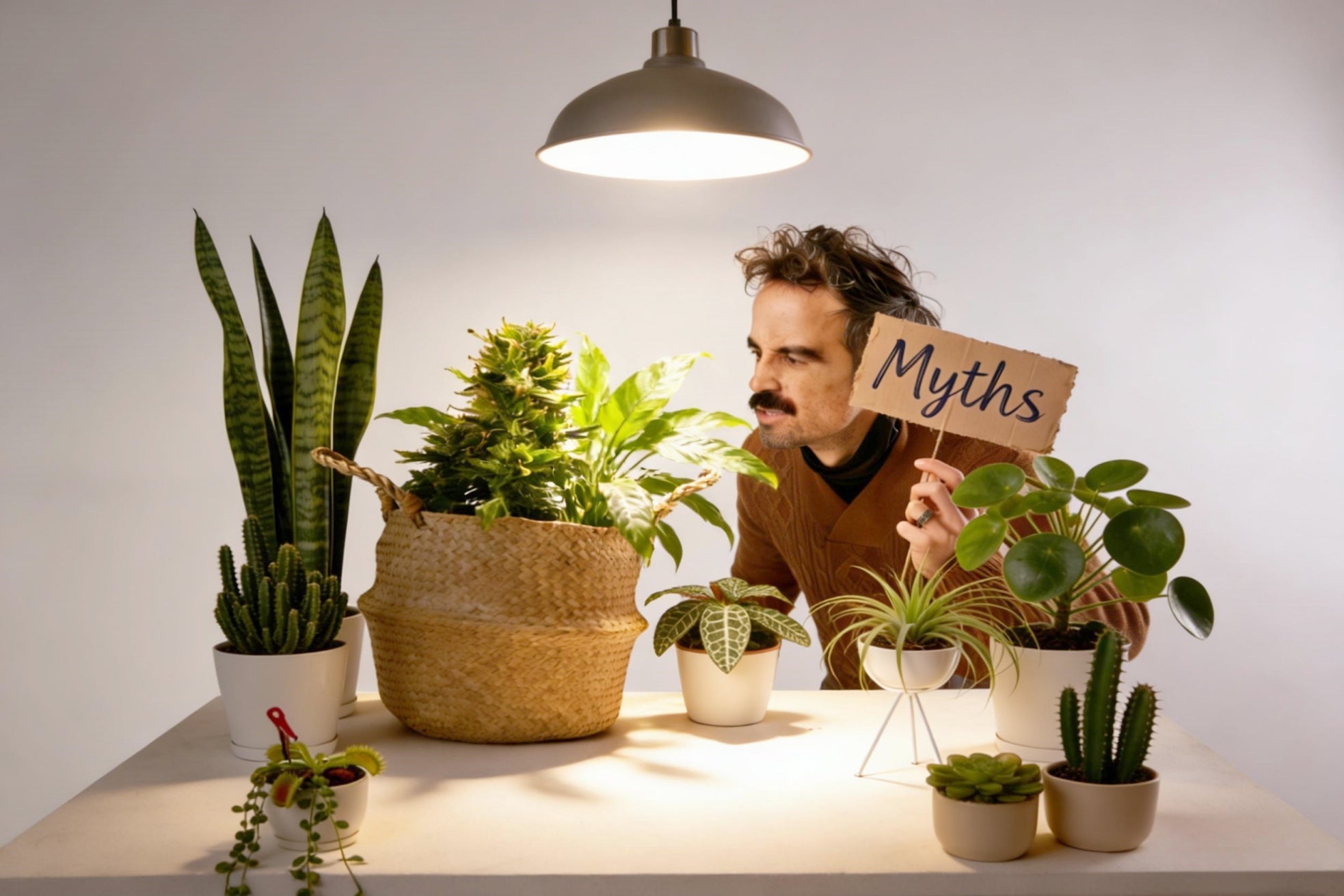
Hey there, fellow plant enthusiasts!
As the days get shorter and we spend more time cozied up indoors, many of us turn our attention to our leafy companions. Maybe you're dreaming of fresh herbs for winter stews, or you're determined to keep that fiddle leaf fig thriving until spring. If you've ever considered a grow light, you've probably also stumbled upon a jungle of confusing - and often contradictory - advice online.
It's enough to make anyone hesitate. Are the purple lights better? Is this new laser tech going to make my LEDs obsolete tomorrow? Let's have a real, down-to-earth conversation about what's true, what's hype, and what actually matters for your home and your plants.
Here's What We'll Unpack Together:
- The High-Tech Hype: Are lasers really replacing LED grow lights?
- The UV Question: Is extra ultraviolet light a secret weapon or a hidden hazard?
- The Eco-Worry: Does my indoor garden contribute to light pollution?
- The Intensity Trap: Is "brighter" always better for plant growth?
- The Spectrum Debate: Are full-spectrum lights just a marketing gimmick?
Let's Start With the Facts: A Quick Reality Check
Before we dive deep, here's a clear snapshot to separate the common myths from the home-gardening truths.
|
The Myth You Might Have Heard |
The Reality for Your Home Garden |
Why It Matters to You |
|
"Lasers will make my LED grow light obsolete." |
Not for home use. While fascinating for large-scale farms, lasers are currently far too costly and complex for household gardening. |
You can invest in a high-quality LED with confidence - it's the practical and powerful standard for indoor growing. |
|
"Adding UV light will make my plants stronger." |
Risky and unnecessary. UV can harm plants and is a safety hazard for people. The CDC's NIOSH warns that UV radiation can injure eyes and skin. |
Your plants' safety and your own come first. A balanced spectrum without unproven gimmicks is the way to go. |
|
"My indoor lights are bad for the environment." |
Only if they shine outside. As the National Oceanic and Atmospheric Administration (NOAA) explains, light pollution is caused by outdoor lighting that obscures the night sky. |
You can enjoy your indoor oasis with a clear conscience by using timers and directing light thoughtfully. |
|
"The brighter the light, the faster the growth." |
False. Every plant has a "light saturation point." Beyond it, extra light wastes energy and can stress or burn your plants. |
Providing the right amount of light is key - it saves energy and often produces healthier, higher-quality growth. |
|
"Full-spectrum lights are just marketing." |
Outdated thinking. Outdated. Research shows plants use more than just red and blue light. Michigan State University Extension notes that light quality (spectrum) affects plant shape, size, and color. |
A balanced full-spectrum LED supports robust plant development and is far more pleasant for your living space than harsh purple light. |
Myth 1: "Don't Buy an LED - Lasers Are the Next Big Thing!"
The Bottom Line: Exciting for research labs, impractical (and unnecessary) for your kitchen herb garden.

Here's the Full Story:
It's true that researchers are exploring the potential of laser diodes in agriculture. In highly controlled settings, specific lasers can deliver light with extreme precision.
Why This Isn't Relevant to Your Home:
Think of laser grow lights as a Formula 1 race car - incredibly advanced for a specific track, but completely unsuitable for your daily school run or trip to the market. For home gardeners, the current barriers are insurmountable: prohibitively high costs, complex cooling requirements, and systems not designed for the diverse, small-scale needs of a household plant collection.
What You Should Focus On Instead:
The real innovation is happening within LED technology itself. The latest industry standards, such as the DLC Horticultural V4.0 requirements, are actively pushing LED horticulture lights to become more efficient and "plant-smart" than ever before by raising efficacy benchmarks. As the U.S. Department of Energy's Solid-State Lighting Program outlines, LED-based technology still has significant room for growth and is actively being advanced through national initiatives to achieve its full potential as a foundational lighting technology. This is the proven, accessible innovation that powers successful home gardens.
Your Practical Takeaway: The trusted LED grow light is not being replaced; it's being refined. The best lights for indoor growing you can buy today are advanced LEDs that brilliantly balance performance, safety, and value for your specific needs.
Myth 2: "A Little UV Light is a Secret Booster."
The Bottom Line: Tinkering with UV at home is a bad idea that poses real risks.
Let's Break Down the Danger:
This myth stems from observing professional, controlled-environment agriculture, where specific UV-B wavelengths are used in tiny, measured doses for specialized goals, like influencing plant compounds.
For Your Living Room, It's a Hazard:
1.It Harms Plants: UV is a stressor. Incorrect exposure causes "photo-oxidative stress" - essentially giving your plants a damaging sunburn, which stunts growth.
2.It's a Human Health Hazard: Ultraviolet radiation is not safe for casual exposure. The National Institute for Occupational Safety and Health (NIOSH), part of the CDC, clearly warns that "UV radiation can cause injury to the eyes and skin". Why risk your family's health for an unproven plant "boost"?
3.It's Not a Shortcut: Plant health comes from a complete environment: balanced led light plant growth, consistent watering, and good nutrients. A single stressful wavelength isn't a magic bullet for health.
Your Practical Takeaway: Protect your family and your plants. Choose a light engineered with a safe, complete spectrum. Look for brands that are transparent about their light composition and prioritize your well-being. A light shouldn't come with a warning label.
Myth 3: "Isn't My Indoor Garden Adding to Light Pollution?"
This is an important and eco-conscious question. Concerns about artificial light harming nocturnal creatures like moths and fireflies are absolutely valid - for outdoor lighting.
Here's the crucial distinction: Ecological light pollution occurs when artificial light escapes into the night sky, disrupting ecosystems. This comes from streetlights, bright signage, or unshielded greenhouse with lights. As explained by the National Oceanic and Atmospheric Administration (NOAA), it is "excessive or misdirected artificial outdoor lighting" that obscures stars and affects animals.
If your grow light is inside your home, its glow is contained. By using a simple timer to give your plants a dark period (which they need!), you're creating a self-contained system. Your indoor garden is a personal, eco-friendly sanctuary.
Your Practical Takeaway: Enjoy your green haven guilt-free. Be mindful by using timers and positioning lights away from windows at night. You're bringing nature inside, not disturbing it outside.
Myth 4: "Crank Up the Brightness for Maximum Growth!"
This might be the most common - and costly - mistake. Plant biology doesn't work like a simple volume knob.
The Science of "Enough":
Every plant has a light saturation point. Imagine a sponge: once it's full, adding more water just creates a mess. Similarly, beyond its saturation point, a plant cannot use extra light for photosynthesis. The excess energy creates wasteful heat and can cause photoinhibition - overwhelming and damaging the plant's very systems you're trying to support.
Precision Over Power:
Modern gardening is moving toward intelligence, not just intensity. The goal is energy efficient grow lights that deliver the right amount of photons where and when the plant needs them, minimizing waste. Resources from leading agricultural universities, like Washington State University Extension's guide to LED plant lights, provide practical advice for home growers on selecting efficient lights and matching light levels to plant needs, which is the key to healthy growth without waste.
Your Practical Takeaway: Successful growing is about consistent, appropriate intensity. This approach saves energy, reduces heat stress, and leads to higher-quality, happier plants. Always tailor the light intensity to your specific plant's needs, not the maximum setting on your dial.
Myth 5: "Full-Spectrum is Just Marketing. Purple Lights Are More Efficient."

This persistent myth is based on outdated science. Early LED plant lights used only red and blue LEDs (creating a purple "blurple" glow) because chlorophyll absorbs these colors well for photosynthesis. However, plants use a broader spectrum. Michigan State University Extension highlights that light quality (spectrum) significantly influences "plant morphology (how the plant grows), development, and even taste or color".
Why Modern, Full-Spectrum Light is the Superior Choice for Homes:
Plants evolved under the full spectrum of sunlight, and they use a wide range of wavelengths for different processes. A full-spectrum LED that emits a balanced, white light offers key advantages:
· Better Plant Structure: It encourages compact, sturdy growth with shorter stems, preventing the leggy, weak stretching common under blurple lights.
· Superior Diagnostic Ability: A light with a high Color Rendering Index (CRI) shows your plants' true colors. You can easily spot a pest problem, a nutrient deficiency, or simply admire the vibrant, healthy green of new growth.
· Pleasant for Living Spaces: This is non-negotiable for a home. A natural white light (like 4000K daylight) integrates beautifully into your decor, enhancing your space rather than casting an alien, laboratory-like glow.
Find Your Light: A Quick Spectrum Guide
|
If Your Priority Is... |
You Might Lean Toward... |
Because... |
|
Pure, high-intensity fruiting/flowering (e.g., for a dedicated grow light greenhouse) |
Specialized red/blue or professional grow light spectra. |
Maximizes photon delivery for specific commercial crop stages. |
|
Healthy growth + a beautiful living space (e.g., herbs, houseplants, grow lights for veggies) |
A high-quality full-spectrum white LED. |
Supports robust plant health and looks like a natural, welcoming part of your home. |
Your Practical Takeaway: For a garden that is part of your home, full-spectrum light is the clear winner. It supports the whole plant and respects the aesthetics of your living space.
Bringing It All Home: Light That Fits Your Life
Cutting through these myths brings us to a simple, clear philosophy: the best light for indoor growing is one that works effectively, feels safe, operates efficiently, and brings you joy.
At SANSI, this belief guides our design. We start with a gentle, full-spectrum 4000K daylight foundation because it supports healthy plants and is comfortable for your home. We use ceramic cooling technology to ensure our lights run safely and last for seasons.
We design for your real life. Whether you need a simple bulb, a sleek 3-foot light bar, or a versatile wall-mounted fixture, the goal is the same: to provide a reliable, gentle sun that helps your indoor garden thrive - simply, beautifully, and successfully.
Ready to see the difference? We invite you to think less about confusing specs and more about the quiet joy of a thriving plant. The right light doesn't complicate your hobby; it makes it effortless. Here's to a winter filled with more growth, more green, and the simple satisfaction of getting it just right!
P.S. Have you heard another grow light myth we haven’t covered? Or are you still puzzling over a specific question? Share it with our community in the comments below - let’s keep the conversation growing!
Still Have Questions? Your Quick Grow Light FAQ
Q1: Are "full-spectrum" and "white light" the same thing?
A: Not exactly. Full-spectrum refers to a light that covers a wide range of wavelengths similar to sunlight, which can include both white and slightly tinted outputs. A high-quality full-spectrum LED usually emits a pleasant white light (like 4000K daylight), ideal for homes.
Q2: How can I tell if a light is truly full-spectrum when shopping online?
A: Look beyond marketing terms. Check for a detailed spectrum chart—reliable brands provide this. The curve should show smooth coverage across blue, green, and red wavelengths (400–700 nm), not just isolated spikes. Also, a CRI (Color Rendering Index) of 80+ indicates balanced, natural-looking light that reveals true plant colors. (As we busted in Myth 5, plants use a wide range of wavelengths for healthy growth—not just red and blue.)
Q3: If "brighter isn't better," how do I find the right light intensity without burning my plants?
A: Start with the manufacturer’s recommended hanging height. Watch your plant’s response: if leaves appear bleached, yellow, or curl inward, move the light farther away or dim it. If stems stretch or lean toward the light, increase intensity or lower the fixture. Your plant’s growth is your best guide. (This ties back to the "Intensity Trap" we busted earlier—every plant has a saturation point.)
Q4: What safety certifications should I look for in a home LED grow light?
A: Always choose lights with ETL or UL certification marks. This means the product has been tested by an independent lab for electrical safety in North America - your simplest assurance against fire and shock risks.
Q5: Is a timer necessary, or can I manually turn the light on and off?
A: A timer is strongly recommended. It ensures a consistent photoperiod, which plants rely on for healthy growth and flowering. Inconsistent light schedules can stress plants and disrupt their cycles. Plus, it saves you effort and helps contain light indoors.
Share:
Fresh Herbs All Winter: Your Kitchen Window Sill Garden Guide
The 2025 Christmas Gift Guide: Thoughtful LED Light Gifts for Everyone on Your List
7 comments
It is essential to clear up these misconceptions. Many users still focus on outdated metrics, so emphasizing the efficiency of full-spectrum LEDs over traditional ‘blurple’ lights is a necessary technical correction for the community.
Very great walk through of growlights. However, i would add, always get them dimmable. It ensures that you can use the lights in many situations. Your setup will always be changing and so will you light requirements. Especially in an indoor garden.
Grow light technology can be confusing and this provides some clarity!
I have great success with full spectrum Sandi LED lights for my houseplant friends! Thank you Sansi 😍🪴
Thank you for busting those myths! I was wondering something else: do full spectrum lights have a negative effect on sleeping habits for us humans? That would be an interesting topic!